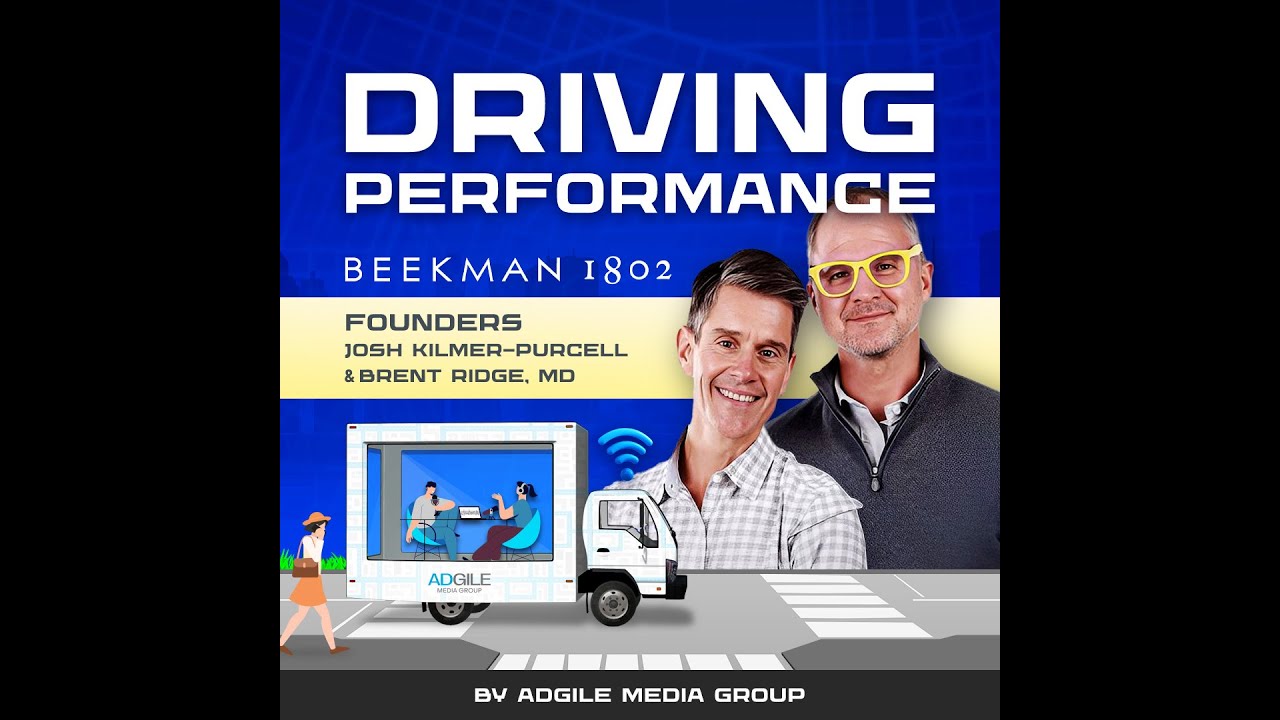
Live from Driving Performance in New York
Adgile co-founder Max Flannery sits down with Beekman 1802 co-founders Dr. Brent Ridge and Josh Kilmer-Purcell for a story that is equal parts unexpected, heartwarming and entrepreneurial.
Josh grew up in Wisconsin and came to New York for advertising; Brent grew up in North Carolina, built a career in medicine and helped launch Martha Stewart's health and wellness division. An apple-picking trip upstate led them to buy a small farm. Then a neighboring farmer, John, wrote asking them to take in his 80 goats. They said yes, the "original kindness" behind Beekman 1802.
When the 2008 recession took both their jobs, they made goat milk soap. Early press led to a reality show, a retail breakthrough with Anthropologie, and growth on QVC and HSN. Today they have sold more than 60 million bars of soap and partner with Ulta Beauty. They also share lessons from their book, G.O.A.T. Wisdom, including the 51% rule.
Listen to the full episode
Watch on YouTube, or listen on Spotify, Apple Podcasts or everywhere else. The full transcript is below.
Full transcript
Transcript of Driving Performance S3E7 with Dr. Brent Ridge and Josh Kilmer-Purcell of Beekman 1802, generated from the episode audio and lightly edited. Watch the full episode on YouTube.
0:14 Well, welcome to season 3 of Driving Performance. I am one of your hosts, Max Flannery. I am a co-founder of Adgile Media Group and currently serve as president. I'm here with Brent Ridge and Josh Kilmer-Purcell, the two co-founders of Beekman 1802. Gentlemen, welcome to Driving Performance. We're happy to be here on the corner of Union Square in New York City. I was just going to say for those that are only listening to the audio, can you please describe what this unique setup is? Well, this is the best podcast studio we've ever been in. And it is on the corner of Union Square in New York City. And it's a truck with acrylic. It's acrylic, right? or glass uh glass on three sides. And so people are walking down New York City totally ignoring us that we're doing a podcast. It's like being in an aquarium, but without water. There's not going to be water. There's not going to be water. Um well, thanks again for joining. Um and since we are filming in the back of a truck, the theme of this podcast is going to have four truck stops. And so we're going to start with your personal stories. We're going to then go to your professional story. We're then going to play a game called the hot box where we do rapid fire questions. Uh two two options each um to to just learn a little bit more about you. Uh and then we're going to do a little bit of an outro and and let you uh maybe plug that book. Um so let's start with with stop number one and your personal story. Um let's just start from the beginning. Where did
1:49 you guys each grow up? And um and I guess how did you end up buying a farm in upstate New York, having your own reality TV show, and winning Amazing Grace? Well, you just told our whole story about Yes. So, well, okay. So, Brent and I, we're a couple. We've been together since uh 1999, so 26 years. I grew up in Wisconsin. He grew up in North Carolina. We both moved to New York City as young adults. Uh I was working in advertising. I was a writer. I was a drag queen at night and uh and Brent was a physician and then he started working for Martha Stewart. He started her health and wellness division and in 2006 we were driving in upstate New York. We were going apple picking uh just like a weekend getaway and we we found this farm that we loved in a little town and we bought it. And then we got a letter in our mailbox from a neighbor. His name was Farmer John and he was losing his farm. He had 80 goats and he had nowhere to bring them and he asked if he could bring them. Bummer. So we said that was the original act of kindness that started be nature. Interesting. Okay. So we say two key ingredients in everything we make goat milk and kindness. So it's that first act of kindness bringing John in cuz we weren't planning on starting a business. It was just like a week at home and then big recession 2008 we both lost our jobs recession and we literally Googled what can we make with goat milk and the first thing that came up with was soap. Interesting. and now 60 million bars of soap.
3:20 That's a great story. So, I I was going to ask, was it the chicken or the egg or was it in this case the goat or the milk that that was the impetus for um for it? And it seems like similar to like it reminds me of Dollar Shave Club. They had a warehouse full of razors and they were like, "How do we get rid of these?" And so, you had the inventory and you were trying to figure out what to do with with that. Kiss you lemon. make lemonade like US goat milk and we started a interesting company. That's awesome. Um is there from a a product perspective is there additional health benefits for it being goat milk associated? There is. Now when we first started we didn't know this but after we started making a bars of soap and we started hearing back from our customers all of whom we call neighbors and they were like this is really helping my skin particularly about eczema or psoriasis. And so I thought this is really fascinating as a physician and a scientist. And so I just started researching the goat milk. And the first thing that we learned about goat milk was that it had the same pH as human skin. So when you cleanse with it, you don't disturb the pH of the skin. Got it? Um so you don't disturb the barrier. And then what we've learned over 16 years of subsequent research is that there are 31 key nutrients in the goat milk which nourish the microbiome of the skin and help repair the barrier of the skin. It truly is a remarkable skinare ingredient. So Brent Brent's the doctor. He's a lot of like nerdy science. Is one of our stops nerdy? It's not.
4:50 I will translate. Okay. If you need it. Okay. No, I think that that made a lot of sense. it. I mean, it honestly reminds me of uh Tom and I's story with starting agile is we just thought there's a billboard, there's a white truck and and then we get all this feedback from our clients saying we're doing it not because it's cheap because it makes it look like our product's being delivered everywhere. People don't know that it's an ad. It makes it look like So, it's life is uh serendipitous. And we're not we're not just company founders. We're agile customers. You are you are one of the thrilling things for us um we have the trucks going around New York City is when customers neighbors would send us photos. I was amazed at how many photos just random people would reach out I saw your truck today so many trucks. I love this too. Last year we got the chance to ring the bell on NASDAQ. The opening bell on NASDAQ and of course it's not good enough anymore just to have your brand on the billboard in Times Square at NASDAQ. Now you have to have your own truck. You have to have the truck there, too. Ask that when you ring the bell. Oh, that place is gonna beile. That block is going to be flooded when we uh when we IPO. Um couple more personal questions. work life balance is a huge a huge topic and so being co-founders as well as more romantic partners and life partners. Um, how do you how's that been? And how do you how do you separate, you know, and not bring the conflict from home into the office and the conflict and all this?
6:24 You don't you don't if you're if you're an entrepreneur, your your life is going to be your business for like at least the first 7 to 10 years, right? And you just have to prioritize. You know, if you want to be an entrepreneur, you have to know that that's the trade-off. If you want work life balance, probably don't be an entrepreneur. So you can count but for us and we talk about this in good wisdom is we developed something called the 51% rule and this applies to any type of relationship business partner or mentor relationship. Whichever person is the most passionate about one particular area of the business decision that's being made or whatever whoever is the most passionate gets the extra 1%. Got it? It's not who's the most skilled, it's whoever has the most passion. Because if you have the most passion, you're you're going to try harder to make it work, right? Cuz you don't want your partner to tell you I told you so. I like that a lot. And I think that Tom and I subconsciously do that. You will. How do you get together? You subconsciously because I can It's something I'm like, "Yeah, I kind of think this is it, but I don't really care." And I could tell he cares. It's like, "All right, we'll just go with you. Do yours." And then it's so powerful, too. And what it enables you to do is for the first draft, the 49%. Is that you expect them to argue their point up to a certain level? You never want to say, "Oh, no. I'm just going to roll over." And that arguing makes the the decision sharper. Sure. At the end of the day, whoever has the most passion is going to get try the hardest to get it done. I want to say something about work life balance.
7:56 So, I think too many of us think of work life balance as every single day like how much am I going to work, how much am I going to play? If you're an entrepreneur, work life balance is the course of your business. So your work life balance is work your ass off for the first 7 to 10 years and hopefully then your life will have a balance and it's a long Right. Yeah, I agree with that. Um, next question is on um on the fact that you're both members of the LGBTQ community. Um, there's been a lot of talk of how gender or race impacts the easiness or or it adds struggle to an entrepreneurial journey. There's a lot of documentation about it's harder for women to raise money, things like that. Have you felt like that has either been a a crutch or a a plus to your journey or is is it kind of is it gender and and race do you think are more prominent? Well, thanks for outing us. People thought we were brothers 20 something years. We were just walking through elsewhere last week and someone shouting it's the Beman brothers. Um, so for us being LGBTQ being gay, um, when we moved to Sharon Springs, New York, very rural area, very conservative area. Um, but it was we we have never once had any sort of homophobia or or bias against us in in our community. And I think we've always been really upfront about repres representing our community.
9:33 Uh, and we've never had any issues with it. I mean, there are a couple of times when we probably got overlooked for an opportunity that we wanted because we were a gay couple. Um, but there have also been times where we got opportunities because we were a gay couple. So, it balanced you out. And on social media, one of the great things is if and this is very very random. If somebody says, you know, something that's homophobic on our social media, it gives our customers, our neighbors, our loyal customers a chance to go on like really riles them up. Yeah. So it's like build interesting. Um so given the fact that you sell a physical product and now many different physical products um wanted to get your thoughts on how and if um tariffs are impacting the future of your business. Yes. Uh I all of our products are made in the United States. All of our products are made in the United States, but some of our gift packaging um is sourced in China and so we've had to look at a little bit how many of those we're bringing across how that's going to change our holiday gifting strategy. Um unfortunately because we are mostly a made company world, but I think most of businesses we speak with now, a business can plan for anything. You can plan for a higher cost. you can plan for, you know, lower margins, but you can't plan for chaos. And so, not knowing what's going to happen the next day really impacts is is more of an impact than the tariffs themselves. Sure. Um, as far as like was your first product just a bar soap? Yeah. And so now, how many SKUs?
11:10 Oh, we across all of our different fragrances and skincare, we have about 300 SK. Okay. So, I'm curious what that what that projection looks like. like h how did you come up with product number two and now how do you come up with product 301? I'm sure there's a huge team now but it was probably much smaller for product 2 3 4. Yes. Well, in the very beginning our first big national retail partner was Anthropology. Okay. And they had bought in the soap and the soap was so successful for them. They then gave us the ideas for the next three products. Got it. Um and so we worked with them to develop those first set of products. And then by the time that was kind of reaching its peak, we got offered to be on TV doing TV retail. Yep. And then that just exploded in the business. Uh and really the customer then started dictating what we make. And we we say Beekman Neighbors because a lot of people come to us because they have sensitive skin issues. And so Beekman neighbors want to use Beekman head to toe. So if we don't make it, they're always asking for. And so that's how we gauge. Got it. The customer is always going to tell you what they want. Right. Okay. Um, on the marketing topic, how do you guys think about marketing and why was agile the your favorite campaign that you've ever run? You know, we did really want to work with agile because we understand um disruption disruption kind of gorilla type marketing and trying to get people's attention. And I'll tell we'll tell you a couple stories. One was back in when we first started the company uh we had the opportunity to do a reality TV show. Yep.
12:47 That was documenting kind of the start of our company and two CD slippers moving to a farm. And when the show premiered, the publicist would send us out to all of these events in New York City to be on the red carpet and technically, you know, you would have celebrity walk by and then we would come up and nobody would know who we were. And so after the second or third time, like how can we stand out? And so we said, okay, we're not just going to wear our suits when we go on. We're going to wear our farm muck boots with our suits. So then from then on out, every time we were on the red carpet, everybody remembered, oh, that's the guys, the guys from afar. Um, and that became our calling card. And I I think that the great thing about agile for us, you know, we're not we're not a small startup, you know, we're a mediumiz company now, but we're competing against the L'Oreal and really big big brands. And I think what's so great about the trucks is it just made us look so much bigger than than we are. Um, and like we said, so many people in New York City when we ran here were just texting us photos. That's awesome. That's actually what's so great about the way you guys think is, yes, you could have just done a podcast sitting at your desk, right? But the layers of storytelling that you have just in the production of your podcast, putting the truck on a highly trafficked corner, people can see you doing is just really, really where there's more air conditioning. Well, speaking of well, we can get to the hot box in a in a second. Um, last question before we get there is just what's the future look like for Beekman?
14:24 What are you excited about? Um, I know that there were there was a recent financial transaction. Are you IPOing? Are you We're ways away from IPOs, but we are super excited to continue growing in North America. In the United States, we are exclusive with Ulta, Ulta, Beauty, and then we're on QVC and HSN. We're the number one skincare brand across both of those networks. Um, and you know, we'll be looking for international expansion sometime in the next couple of years. And then of course, goat wisdom, spreading our goat wisdom. And we wanted to write our business book um because you know, we're a company now that's about 18 years old. Yeah. And we saw all these business books and business marketing tools out in the world and they were all like geared towards this like sort of Elon Musk type, you know, gamble it all, risk it all. Um, and we wanted to do something that showed how we built it, which like really methodical step by step using age-old wisdom to take those, you know, take those steps. Greatest of all time wisdom. And so what we did in the book was we took 12 sort of maxims or proverbs that that we always use, that our grandparents use, that our parents use, and then we showed how they apply to modern business. Cuz we I we always say there's two ways to be an entrepreneur. If you're going to shoot for the moon, you can either build a rocket or a ladder, right? And if you build a rocket, chances are it's, you know, you might make it, but it's most likely going to crash. If you build a ladder, might not make it, but you're always
15:56 going to be a little further along than you started. So there are out there for the lateral entrepreneurs. Interesting. If you can't afford a Harvard MBA or you can't get into Harvard, you get a Harvard business. It's all I love it. Well, it's a very clever name and uh I look forward to reading it. All right, guys. We're going to the hot box. Rapid fire questions to uh better understand your guys' personality. You get two options for each one. I don't have much of a personality. You might need more options for him. Okay, starting strong. Would you rather give up email or give up Slack? Do you use Slack? I not on Slack. Our team does, but we they don't include us. Okay. All right. You're not included in the SL. Okay. Um, cold plunge or hot tub? Hot tub. Cold plunge. Sweet snacks or salty snacks? Salty. Sweet. Opposites attract, huh? Um, coffee or tea? Coffee. Winter or summer? Winter. Spring. I like that answer. Um, neat or messy? Neat. You're pretty neat. Yeah, he's neat because I clean up after him. Is it called DTC or D2C? DTC. I don't know. D. D. Yeah. Yeah. Um, you have $50. Are you putting it on red or black? Red. Red. Um, board games or video games?
17:32 Board. Same. Beach house or ski house? Ski beach. Work remote or return to the office? Office. Sunrise or sunset? Sunset. What? You're up every morning at 3:30. Yet I'm already working, so I miss the sunrise. I sleep at sunset and then I sleep by seven o'clock. Okay. I sleep through both. Uh Twitter, LinkedIn, Instagram or TikTok? We just talked about this. None of the above. No, right now LinkedIn. LinkedIn. It has to be LinkedIn. Um live music or a DJ? Live music. DJ. Give up bread or give up cheese? Bread. No. Neither. I'm not. Start early or leave late? Start early. Yes. Trucks or billboards? Trucks. Of course. Would you rather see good news or bad news first? Bad news first. Bad news always. Well, the bad news is we're at the last stop. Oh, it's over. It's almost over. Um, so want to let you plug the book. Where can they buy it? And then where can they find you guys? Um, you can find Goat Wisdom wherever books are sold and you can find us at Josh and Brent on LinkedIn, Instagram, Facebook. We're inescapable and our products at bigman802.com or all time. Wonderful. Well, thanks guys. Thanks a lot.